
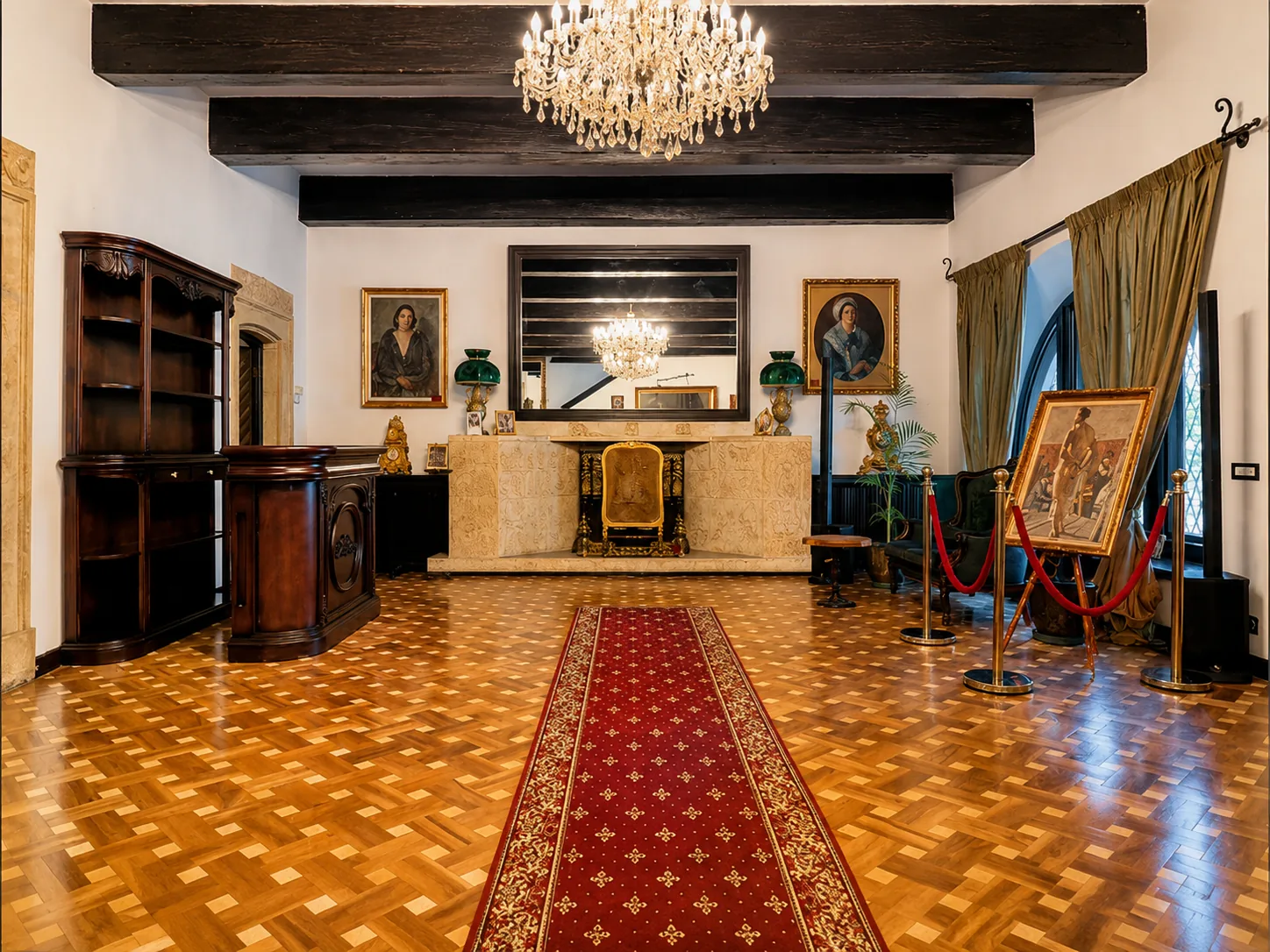
There are spaces that impose themselves before anyone speaks a word. The Main Salon of Vila Tătărescu is one of them — a room where past and present coexist with a naturalness that can no longer be manufactured, only inherited. The moment you cross the threshold, the exposed ceiling beams trace a warm, almost intimate geometry overhead.
A Space Designed for Distinguished Guests
The salon was conceived from the outset to host the Tătărescu family's gatherings. Today, the main salons reflect the same generosity: 100 guests at a cocktail reception, 80 seated for a formal dinner, or 40 in theatre format for a presentation or restricted conference.
The exposed beams, in the Spanish manner, preserve the texture and colour of mature wood. They are the first sign that you will not be renting an event hall, but inhabiting, for a few hours, a truly living house.
The Centrepiece — the Fireplace by Milița Petrașcu
At the far end of the salon, set in an apse, a massive fireplace dominates the wall with quiet authority. It is one of the pieces made by Milița Petrașcu — a Romanian sculptor trained in Paris, the direct pupil of Constantin Brâncuși — for the Tătărescu family's house, authorised in 1935.
The fireplace is never lit: it is preserved as one of the house's works of art, as it was conceived. The door frames are also her work.
Art + concept — not gratuitous decoration, but a piece with meaning, in the home of a Romanian Prime Minister.
The House of Arethia Tătărescu
This was the home of Arethia Tătărescu. The National League of Gorj Women, which she led, commissioned Brâncuși's ensemble at Târgu Jiu (the Endless Column, the Table of Silence, the Gate of the Kiss), inaugurated in 1938. The invitation to Brâncuși dates from 1934, before the house, which was authorised in 1935.
Reserving the salon for a private occasion means more than choosing a beautiful setting — it means access to an authentic story, offered with discretion by the EKO GROUP team.
The salons seat up to 80 for dinner and hold up to 100 for a cocktail.